Memorialising the slave trade and slavery
If you’d prefer to listen to the audio version of this article, listen to Matt and Sarah here:
The impressive sculpture you are currently standing in front of is the Gilt of Cain. If you found this memorial hard to find you wouldn’t be the first. Tucked away in Fen Court Garden it is entirely up to the persistence of members of the public to discover this powerful symbol.

An image of the Gilt of Cain
Unveiled by Archbishop Desmond Tutu on the 4th of December 2008, it is the first memorial for the victims of the slave trade supported by the City of London and celebrates the bicentenary of the abolition of the slave trade.
The name of the sculpture, ‘Gilt of Cain’, reflects the dual symbolism of the sculpture. ‘Gilt’ is the gold leaf or paint applied to a surface and refers to the wealth obtained from the slave trade. ‘Cain’ was the firstborn son of Adam and Eve who was condemned to a lifetime of wandering by God after he committed the first murder by killing his brother Abel out of jealousy.
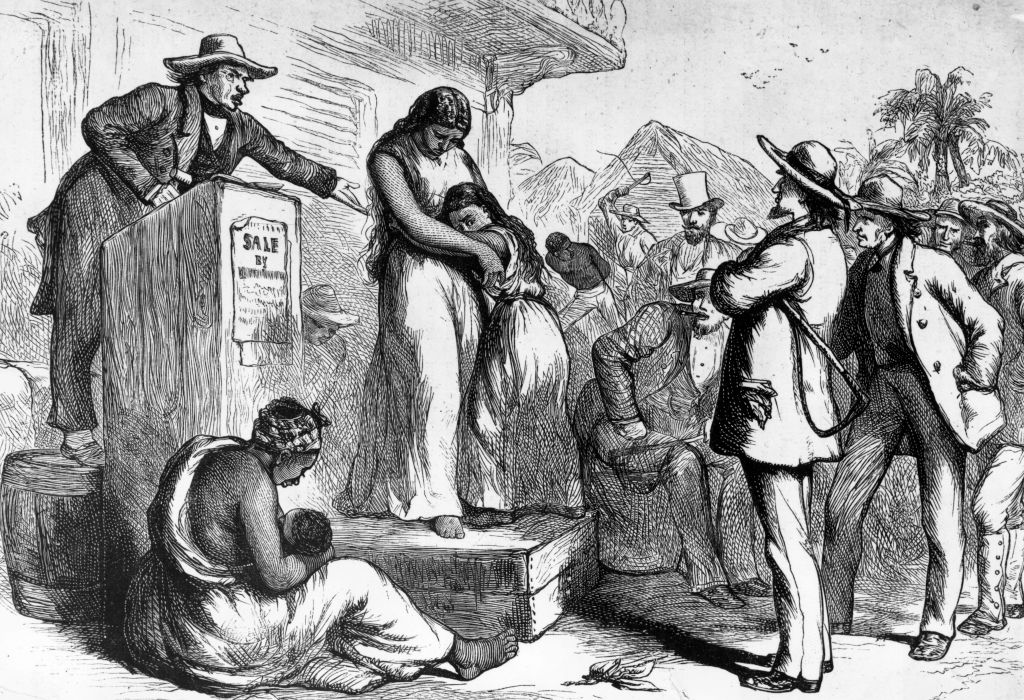
An engraving of a slave auction from the book ‘Cassell’s History of the United States’, by Edward Ollier
This image is from the Slavery Images database
From an economic point of view the granite platform could be viewed as a slave auctioneer’s podium and 17 columns of sugar canes. This image visualises that the wealth accumulated by the sugar industry was built on the backs of the enslaved.
On the other hand, there is powerful religious imagery here too. Situated close by to St Mary Woolnoth Church, it is said that key abolitionist campaigner William Wilberforce was inspired by Reverend John Newton’s anti-slavery sermons there. One could interpret the platform as a pulpit where an anti-slavery sermon would be preached, much like John Newton did at St Mary Woolnoth Church.

The Gilt of Cain poem by Lemn Sissay that is also etched on the monument itself
The poem above includes the line “cut back the Sugar Rush, Cain”. Cain gave an offering of wheat to God, who accepted his brother Abel’s offering of a lamb instead. Considering the poet has described Cain as harvesting sugar, this is another religious metaphor about God’s displeasure with the way sugar was being harvested and perhaps the wider slave trade as well.
Our next stop on the tour looks at the way some firms profited from the slave trade and explores whether firms today are doing enough to acknowledge their own legacy.