Contents
Introduction
Trade became increasingly prominent during the Crusades. A wide range of agricultural commodities and goods such as spices, herbs, lemons, and sugar were brought back to Europe. When the crusaders conquered what became the Latin Crusader States, they found sugar already being cultivated and refined there. They would go on to learn techniques from the Arabs and continue its cultivation during the twelfth and thirteenth centuries for Europeans to enjoy. This page will look at sugar as an example of the development of industry and trade across the Crusader states.
Coins also served an important economic, political and social role in the Crusader States. They were used primarily for payments and exchange, but they also acted as expressions of power and authority via iconography. They gave rulers a unique way of expressing themselves and we can learn about how they wanted to be seen by others and how they interacted with their subjects. This was particularly important for the rulers of the Crusader States, ruling over diverse populations including European settlers and native Christians, Jews and Muslims.
Estimated reading time: 4 minutes
Sugar
Sugar was introduced to Europe by Muslim traders and migrating farmers from the Mediteranean circa 1000. Europeans visiting Muslim Spain became increasingly aware of sugar through luxury trade conducted across the Mediterranean by Italian merchants. Crusaders also encountered caravans in the Holy Lands carrying sugar and took small quantities back to Europe. Sugar was useful for fruit preservation, pastries and candies, the name coming from the Arabic word ‘qandi’.
In Cyprus, many locals did not want to work in sugar production because of how time-consuming it was. As a result, slave labour was imported from the Black Sea area to produce small quantities of sugar. However, some historians suggest that most labour in the industry was non-slave labour, especially as Greek and Syrian immigrants were granted special permits to work in the industry.
Cyprus experienced strong demand for sugar in the fourteenth and fifteenth centuries due to the re-conquest of Syria by Muslims in 1291 and a Papal edict (1292-1344) forbidding trade with Muslims. The European sugar industry only began on a major scale after the loss of the Levant and the shift of production to Cyprus under a mixture of Crusader aristocrats and Venetian merchants. Europe’s first sugar factory was built circa 1400 at Kouklia-Stavros in Cyprus. Sugar was produced and transported in conical pots for trade and consumption, which had funnels for seperating mollases with granulated sugar and came in different sizes suited for different qualities of sugar.
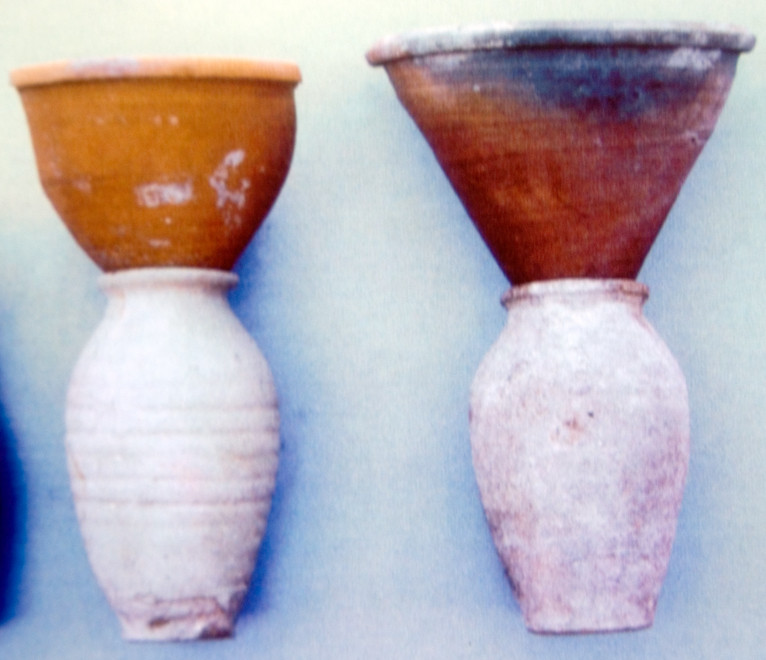

Images and information taken from https://www.fergusmurraysculpture.com/cyprus/history-notes-12-pages/viii-sweet-salt-the-medieval-sugar-industry/
https://dom.com.cy/en/live/blog/sweet-island/
https://www.sultanandthesaintfilm.com/education/cross-cultural-trade-cultural-exchange-crusades/
Coinage from the Crusades
County of Edessa
The County of Edessa (modern-day Urfa in Turkey) was the first Crusader State, established in 1098 by Baldwin of Boulogne.
Some of the coints found in Edessa minted circa 1100 depict a cross, while others show a knight wearing mail armor with a sheathed sword. Inscriptions on these coins include the name Baldwin in Greek and the inscription ‘Baldwin, the servant of the Cross’, possibly referring to Baldwin of Boulogne or his successor. This demonstrates how coins were used as propaganda to communicate political and religious messages, as the count is depicted as a defender of his lands and the Christian faith.
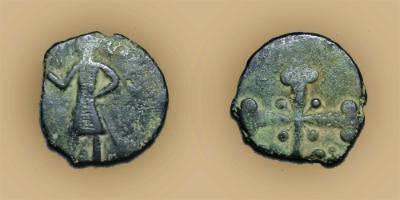
Kingdom of Jerusalem
The armies of the First Crusade conquered Jerusalem on 15 July 1099 with Godfrey of Bouillon the first ruler of the new kingdom. The earliest coins found in circulation in the Kingdom of Jerusalem were either imports from northern Italy and southern France, or from surrounding areas, such as Islamic gold dinars from Fatimid Egypt. The new rulers began minting gold and silver coins in the 1140s.
Examples of coinage imitating islamic designs can be seen with the gold coins (saracen bezants), which were copies of Fatimid dinars, even retaining Arabic Quranic inscriptions. The Islamic design suggests that the Latin rulers felt no need to change the established high-value coinage. Pope Innocent IV eventually banned the coins and their design was changed to include Christian symbols, albeit the text on the new Christian design remained in Arabic.
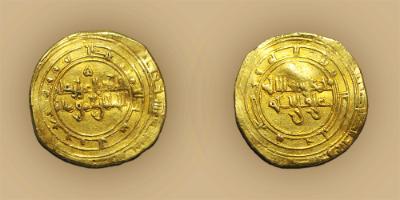
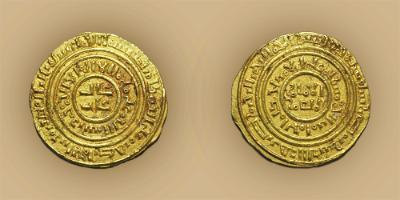
The main silver and billon coins of the Kingdom were of European design. This type of coinage was rare in the early 1100s eastern Mediterranean, and its appearance shows that western currency designs had begun proliferating into the region. They depicted important buildings which functioned as a way of conveying the prestige of the Kings of Jerusalem, while also legitimising their rule. Coins minted during the reign of King Baldwin III feature the Tower of David on the reverse. During King Amalric’s reign in the 1160s, these were replaced by coins which depict the Church of the Holy Sepulchre. The Tower of David was one of the key defensive buildings in Jerusalem and was associated with the biblical King David, while The Holy Sepulchre had become closely linked to the Crusading movement as the site where the rulers of Jerusalem were crowned and buried.
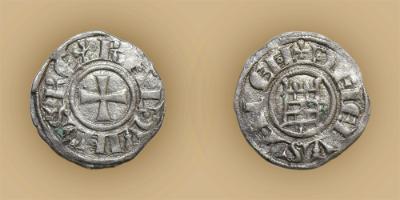
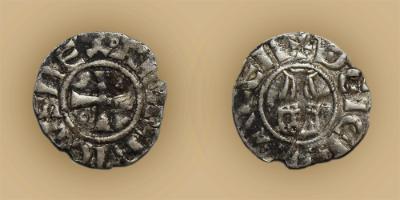
Images and information taken from the Hunterian Museum
Bibliography
”Sweet Salt’: Sugar Production in Medieval Cyprus’, Jumblocracy at https://www.fergusmurraysculpture.com.
‘How sugar made Medieval Cyprus the commercial center of the Eastern Mediterranean’, Dom Live at https://dom.com.cy/en/live/blog/sweet-island.
‘Cross-Cultural Trade and Cultural Exchange During the Crusades’, The Sultan and the Saint at https://www.sultanandthesaintfilm.com/education/cross-cultural-trade-cultural-exchange-crusades.
‘Coinage of the Crusades: Merging East and West’, The Hunterian at https://www.gla.ac.uk/hunterian/visit/exhibitions/virtualdisplays/coinageofthecrusades.